What Actually Keeps a Wristband On
An adolescent psychiatric unit faces the hardest problem in patient safety technology: a safety device only protects the patients who actually wear it. Here is what one clinician's team uses, what other units have suggested, and the science behind why these are worth trying.
Every piece of safety technology shares a quiet vulnerability. A fire alarm only saves a building if it has good batteries. A seatbelt only protects the driver who uses it. A wearable safety band, the kind that helps prevent safety crises, only works when it is being worn.
On most inpatient units, and with the right wristbands, "band adherence" is a small and manageable issue. Inpatient psych units routinely have +95% band adherence. 100% adherence is common. However, in a child and adolescent unit, it can be more challenging (understatement).
If you have never worked on a child and adolescent unit, here is the thing to understand: the resistance you see is rarely defiance. Some of it is ordinary development, the adolescent project of establishing that you are a separate person with a will of your own. A psychiatric unit removes a lot of that control, for safety, at exactly the age when control can feel like survival: meals, sleep, visitors, movement, privacy, all scheduled, all supervised, all decided by someone else. A wristband a stranger asks you to wear is, in that context, one more thing being done to you rather than a safety feature. The units that do well here stop treating a band coming off as a behavior problem to be corrected and start treating wear as buy-in to be earned.
Cody Mulverhill has spent a lot of time on that buy-in problem.
Cody is a milieu coordinator on his hospital's adolescent Special Needs Unit, or SNU, a unit specifically for patients with an autism diagnosis or a developmental disability. There are only three such units in Massachusetts, and Westborough Behavioral Health Hospital runs two of them.
His certification is RBT, Registered Behavior Technician, which means the reinforcement work he does is Applied Behavior Analysis (ABA), carried out under the direction of a board-certified behavior analyst (a BCBA). ABA is the foundation of treatment on these units. Cody is also one of his hospital's two primary instructors in RAID, a structured behavioral program used across Signature's hospitals with reinforcement at its core, and he is trained in CPI, the Crisis Prevention Institute's method for de-escalating an acute crisis without force or a power struggle. In practice he does not run any one of these in isolation. He blends ABA, RAID, and CPI into something built around the individual patient.
On a unit like his, that developmental picture is only part of it. A band comes off for reasons as individual as the patients: how it feels against the skin, whether its purpose makes sense, how a new object on the body lands for someone who relies on the predictable. The common thread is not bad behavior to be corrected. It is a person telling you something, one patient at a time.
One idea from CPI is worth holding onto, because it runs underneath the rest: you do not resolve a crisis by winning it. You resolve it by lowering the threat the other person is reacting to, until there is nothing left to fight about.
What follows is a set of approaches Cody and his team use, a few ideas borrowed from other units, and the science behind why each is worth trying. None of them is a guarantee, there is no silver bullet, but it is a quiver of options to have ready.
The obvious place to start: reward what you want to see
Cody started where the science starts: reward the behavior you want to see. Early on, that was mostly verbal. When he saw a patient wearing a band, he said so. "Hey, I like the wristband." Cheap, immediate, and easy to do twenty times a shift. He paired it with tangible rewards the kids already valued, the kind of small collectibles, trading cards and the like, that the unit used as currency for all sorts of behaviors, not just the bands.
This is not improvisation, and on these units it is not informal either. It is Applied Behavior Analysis: a BCBA designs the plan, and RBTs like Cody carry it out. The underlying principle is the oldest one in the field. B.F. Skinner formalized it in the 1950s as positive reinforcement: when a behavior is followed by a desirable consequence, the behavior tends to recur. The structured clinical version, earning something tangible for hitting a defined target behavior, is a token economy, a method first laid out by Teodoro Ayllon and Nathan Azrin in 1968, in a psychiatric hospital, for exactly this class of problem.
Cody also did something more subtle that helps a new behavior stick. He didn't reward at a fixed, forever rate. He started dense, both the praise and the treats coming often, and then stretched the interval: hourly became daily, daily became weekly. In behavioral terms this is schedule thinning, described in Ferster and Skinner's 1957 work on schedules of reinforcement, and it is standard ABA practice for moving a behavior toward maintenance. Frequent reinforcement is good for starting a behavior; to make it durable you fade the reward as the behavior becomes routine. You use the reward to build the habit, then let the habit carry itself.
So far, textbook. If the story ended here, the lesson would be a familiar one: reward the kids, taper the reward, done. Except it is not that simple, and the research explains why.
Why a reward alone isn't enough
Two well-documented effects sit directly in the path of "just reward them."
The first is psychological reactance, named by Jack Brehm in 1966. When people feel a freedom is being threatened or taken, they don't simply comply. They push back, often by valuing the threatened freedom more and doubling down on the forbidden choice. Reactance is strongest exactly where you would least want it: in people who are highly motivated to feel autonomous, which is to say, in adolescents. A program that feels like coercion with a prize attached doesn't defuse that. It can feed it. (A CPI instructor recognizes the dynamic right away: it is a power struggle, and power struggles are the thing the training exists to avoid.)
The second is a bit less intuitive. In 1973, the psychologist Mark Lepper and his colleagues ran a now-classic study with young children who already enjoyed drawing with markers. They offered some of the children a reward for doing the thing they already liked. Afterward, the rewarded children drew less on their own than the children who had been left alone. The reward had quietly turned a thing they did for themselves into a thing they did for a payoff, and when the payoff stopped, so did the drawing. Overjustification; extrinsic rewards, used clumsily, can crowd out the motivation you were hoping to build.
None of this means reinforcement doesn't work. On these units, well-designed reinforcement plainly does. It means a reward is most durable when it is faded on purpose, exactly as Cody does it, and paired with something it cannot supply on its own. Which raises the obvious question: what else is there?
A tool worth borrowing: make it theirs
One idea that hospitals have used successfully is to let the patients decorate their own bands. Markers, color, a name. The band stops being standard-issue equipment and starts being hers.
There is a precise explanation for why this can matter. Self-determination theory, developed by Edward Deci and Richard Ryan, holds that durable motivation grows from three needs: autonomy (I chose this), competence (I am good at this), and relatedness (this connects me to others). A reward touches none of them directly. Letting someone make an object their own touches the first one squarely.
Behavioral economists have shown something related: people overvalue what is theirs, the endowment effect (Kahneman, Knetsch, and Thaler), and value it even more when they put their own labor into it. Michael Norton and Dan Ariely called the latter the IKEA effect, after the wobbly bookshelf we love because we built it ourselves. A blank band is hospital property. A band a patient spent twenty minutes coloring is, in some small way, a possession. The theory says she is less likely to flush a possession away (sometimes literally, we've seen it all).
Personalization also does something useful to reactance. Reactance is a response to lost freedom; a patient who is invited to choose, to decorate, to opt in or hand the band back to the nurse with no penalty, has not lost a freedom. She has been handed one. The same band, offered as a choice rather than a requirement, is easier to accept. Some units link band adherence to natural transitions ("the band goes on when we head to the gym"), which works for the same reason: a predictable, safety-linked norm lands better than an arbitrary demand, and it still leaves the final call with the patient.
What ties it together, and what it doesn't fix
The thread running through all of this, across ABA, RAID, and CPI, is the same reflex: reinforce what you want to see, and lower the threat instead of fighting it. Hand back some control where you can. The science mostly explains, after the fact, why that reflex tends to help.
Now the honest part. None of this is a silver bullet, and Cody would be the first to say so. Even with praise, rewards, and a thinning schedule, some patients still took the bands off. Some flushed them. In one case a patient worked out how to remove a band and showed a few others how to do it too. Read through the lens from earlier, that is less sabotage than communication, and on a unit of kids who learn from each other, it is exactly what you would expect. It is humbling, and it is the reason to hold any "what worked" story loosely.
It would also be easy to write this up as a clever article, "the tricks we used to get the bands on." We won't, because the patients are adolescents in psychiatric care and the band has a safety-tracking function, and the honest question sits right there: isn't this a sophisticated way to get kids to accept being monitored? The reason we think it isn't is the one feature that has to be central, not decorative: it is genuinely optional. A patient can refuse the band. She can hand it to a nurse. There is no punishment for taking it off. A reinforcement program on top of a mandate is coercion with a bow on it. The same reinforcement program on top of a real choice is an invitation, and invitations are what adolescents are wired to accept.
The reason any of this is worth the effort is not an adoption metric. On these units the events that hurt people happen fast, and a band that helps staff respond sooner can be the difference between a scare and a catastrophe. The safest band is the one being worn. The work is getting closer to that without taking from these patients the one thing the unit is also trying to give back: a little control over their own lives.
Things to try
- Treat resistance as communication, not defiance. It changes the whole approach. You are not correcting bad behavior, you are reading what a patient is telling you and earning buy-in one person at a time.
- Lead with the cheap stuff. Specific verbal recognition ("Hey, I like the wristband") costs nothing and can be repeated all shift. Pair it with rewards the kids already value.
- Use rewards to start, not to sustain, and plan the taper. Reinforcement is strong at starting a behavior and weak at maintaining it. Fading the schedule on purpose is standard practice.
- Hand back ownership where you can. Decoration, personalization, and choice are not soft extras; they are how a behavior survives after the rewards fade. This one came from a peer unit and is worth testing.
- Keep it optional, and say so out loud. Optionality is what turns coercion into consent, and it is also what makes the rest work.
- Expect mixed results, and celebrate the small wins. Some patients will still say no, and some will still take the band off. That is not a failure of the approach; it is the population, and it is normal.
Ask Cody what he would tell another unit, and he doesn't reach for a technique:
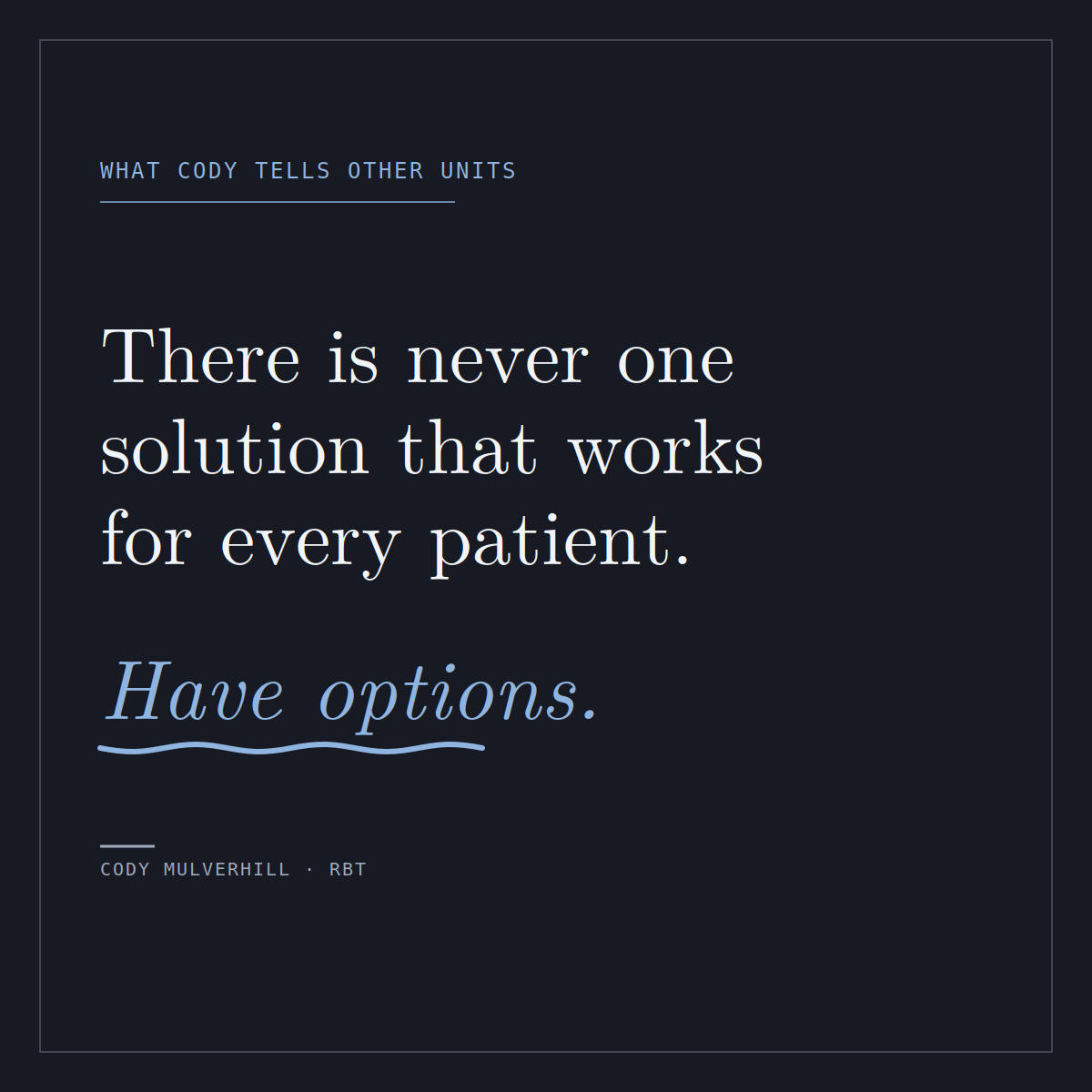
Flexibility is key. Be okay with having a plan, and having to scrap it and try something new the next day. There is never going to be one solution that works for every single patient, so have options. Celebrate the little wins, and don't be afraid to try something new.
About Cody

Cody Mulverhill is a Registered Behavior Technician (RBT) and milieu coordinator on an adolescent specialized needs unit, where he is also one of his hospital's primary RAID instructors and is trained in CPI. He works under the direction of a board-certified behavior analyst (BCBA).
References & further reading
- Skinner, B.F. (1953). Science and Human Behavior. Macmillan.
- Ferster, C.B., & Skinner, B.F. (1957). Schedules of Reinforcement. Appleton-Century-Crofts.
- Ayllon, T., & Azrin, N.H. (1968). The Token Economy: A Motivational System for Therapy and Rehabilitation. Appleton-Century-Crofts.
- Brehm, J.W. (1966). A Theory of Psychological Reactance. Academic Press.
- Lepper, M.R., Greene, D., & Nisbett, R.E. (1973). "Undermining children's intrinsic interest with extrinsic reward: A test of the 'overjustification' hypothesis." Journal of Personality and Social Psychology, 28(1), 129-137.
- Deci, E.L., & Ryan, R.M. (1985). Intrinsic Motivation and Self-Determination in Human Behavior. Plenum.
- Ryan, R.M., & Deci, E.L. (2000). "Self-determination theory and the facilitation of intrinsic motivation, social development, and well-being." American Psychologist, 55(1), 68-78.
- Kahneman, D., Knetsch, J.L., & Thaler, R.H. (1990). "Experimental tests of the endowment effect and the Coase theorem." Journal of Political Economy, 98(6), 1325-1348.
- Norton, M.I., Mochon, D., & Ariely, D. (2012). "The IKEA effect: When labor leads to love." Journal of Consumer Psychology, 22(3), 453-460.
The safest band is the one being worn. See how VisibleHand helps teams respond sooner.