Three Ways to Put AI to Work in Your Facility Right Now
I joke with my friends that ChatGPT is my new primary care provider. Is it because my health system embeds AI into their nurse call line, scheduling, note-taking in office, etc.? No. It's because with a free ChatGPT account I can ask all of the questions that I would have taken to my doctor. I don't expect it to be perfect and I might still need to see my doctor, but AI is very good, and I find myself consulting it more often, on a wider range of health topics, than I ever consulted my PCP, who I saw once every five years.
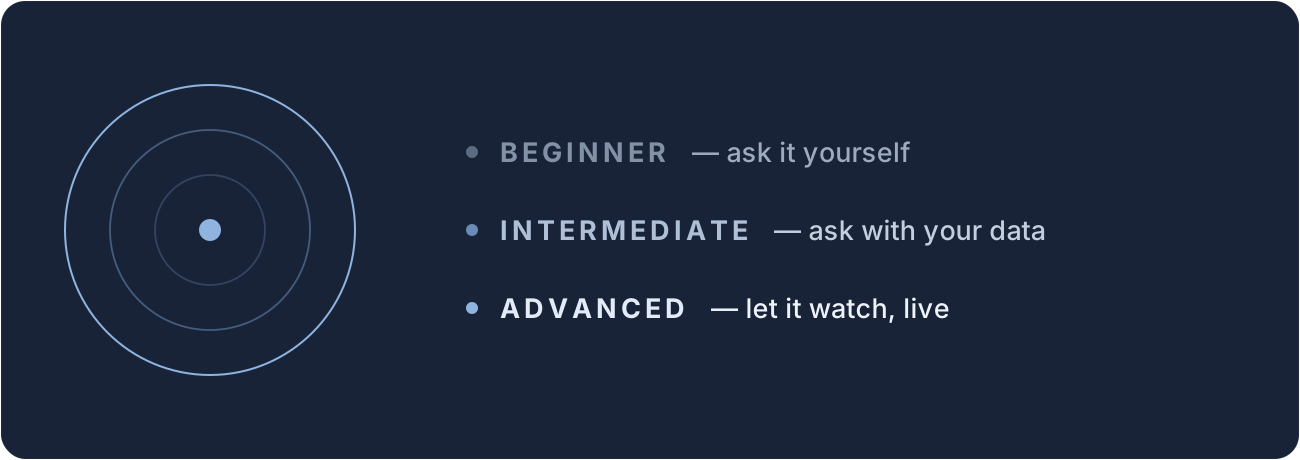
The same thing is happening in behavioral health. While EHRs and technology systems are slowly rolling AI into their tools, caregivers can already get huge value out of basic tools. Here are 3 levels of how you can use AI today in behavioral healthcare: Beginner, Intermediate, and Advanced.
Beginner: DIY, no company policy required
You don't need permission to get value out of AI today. Every clinician, tech, and program director already has access to a tool like Claude or ChatGPT, and there's a lot you can do with it before you ever touch a piece of patient data. A few examples:
- Ask it to walk you through what a strong suicide risk assessment covers, and compare that against your own facility's checklist.
- Have it draft a first pass at a new elopement or contraband policy, so your team is editing a draft instead of starting from a blank page.
- Ask it to explain a new Joint Commission or CMS requirement in plain English before you try to operationalize it.
- Role-play a hard conversation, like talking a family through a level-of-care change, before you have it for real.
- Draft a training memo for new techs on what a complete Q15 note actually looks like.
None of this touches PHI. It's just a very capable, very patient colleague who happens to be free.
Intermediate: your own data, with the right guardrails
This is where it gets more useful, and where you need to be careful. If your facility already has digital documentation, whether that's VisibleHand rounding exports, an EHR report, or a spreadsheet someone built in Excel, tools like Microsoft 365 Copilot now sit right inside Excel and let you ask questions of that data directly.
Important caveat: check with your compliance and IT teams first. Confirm the tool is approved for your facility's data, and that you're following your organization's data handling policy before uploading anything. This tier only works if it's done the right way.
Once that's sorted, a few behavioral health examples of what you can ask:
- Which units or shifts have the highest rate of missed or late Q15 checks over the last quarter.
- What time of day incidents actually cluster on a given unit, by acuity or age group.
- Which staff have the most check overrides, flagged as a coaching conversation, not a disciplinary one.
- How incident rates track against census and staffing ratios over time.
- A quick chart of incident types by unit, built in minutes instead of requested from an analyst.
It's the same data you're already collecting. Copilot, or whatever similar tool your organization has approved, just makes it possible to finally ask something of it.
Advanced: AI-native tools, live and embedded
The step past uploading a spreadsheet and asking a question is having AI live inside your systems, built for healthcare from the ground up. That's the tier we're building toward at VisibleHand: PHI-secure, embedded AI that lets you chat with your own live data instead of exporting it first, plus agentic alerts that don't wait to be asked.
Instead of "pull last quarter's report," it starts to look like:
- Asking, in real time, which units are currently trending over their risk threshold.
- Getting a proactive flag the moment a patient's movement pattern looks unusual, before anyone had to notice it manually.
- Closing the actual gap Q15 rounding has always had. Rounding has been good at documenting that a check happened. This tier is about seeing what's going on in the minutes no one's watching, and catching it before it becomes a sentinel event instead of proving after the fact that the process was followed.
This level takes real infrastructure: PHI security, live data pipelines, audit trails, all built for a hospital, not bolted onto a general-purpose tool. It's coming, and it's the direction we're building.
We put together a short video walking through all three of these levels, along with where the VisibleHand product is headed next:
If any of this is useful, whether that's using AI on your own, getting more out of the documentation you already have, or hearing what's coming with VisibleHand, reach out: zach@visiblehand.io.