The Most Dangerous Safety Problems Look Compliant
Every behavioral health organization has safety processes it depends on every day: observations, rounds, checks, documentation, escalation pathways, shift handoffs, and supervisory review.
Most leaders know whether those processes are required. Most know whether they are documented. Many can tell you how they are audited.
A harder question is this:
If one of those processes started failing today, when would leadership know?
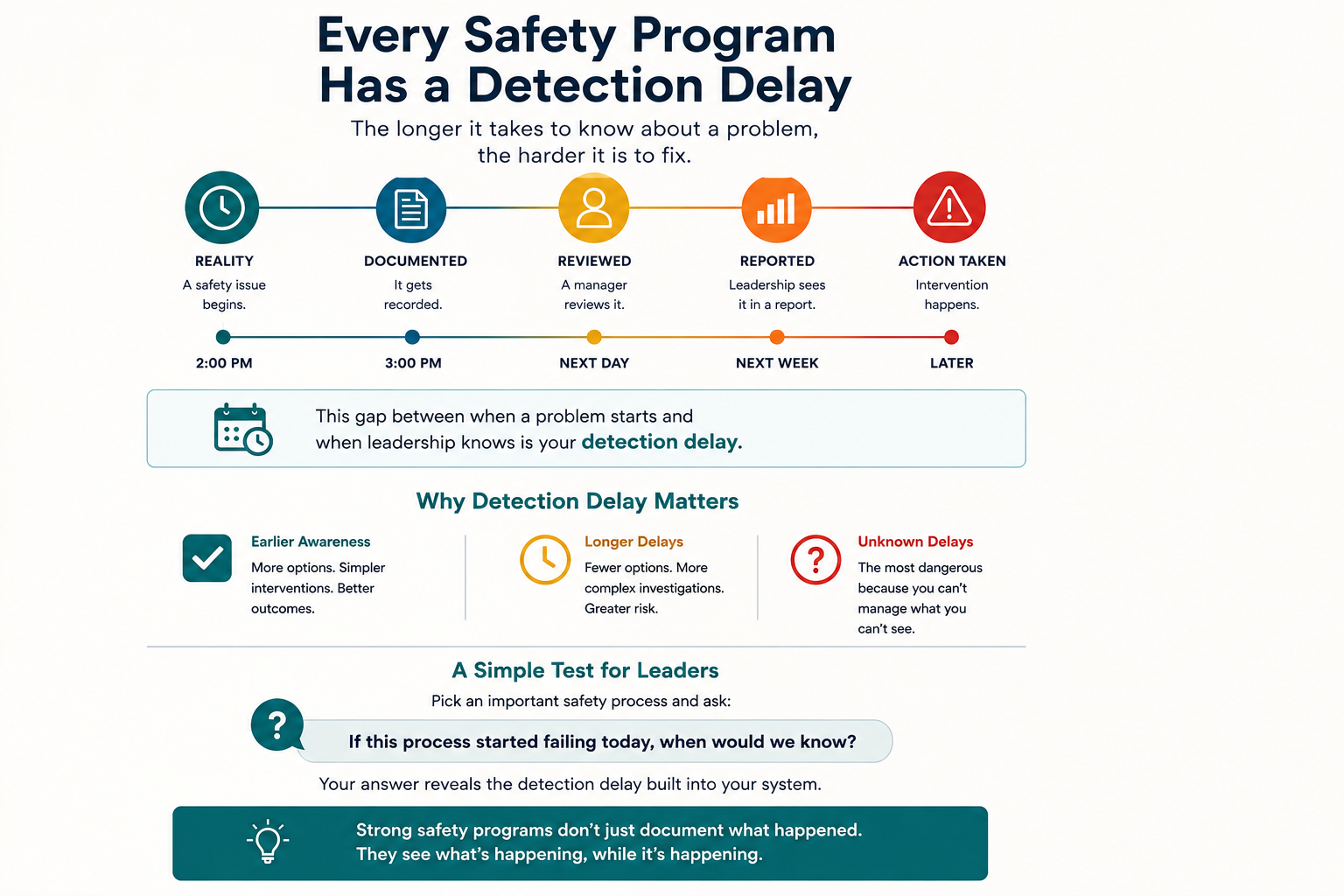
That gap between a problem beginning and the organization recognizing it is the detection delay. Every safety program has one.
The question is whether it is measured in minutes, shifts, weeks, or months.
The Quiet Failure Mode
Safety problems do not always announce themselves as major events. Often, they start quietly.
A unit gets busier than usual. Acuity increases. Staffing is thin. A new employee is still learning the workflow. A few observations are late. A few checks are documented after the fact. The shift gets through the day.
Nothing about that scenario requires bad intent. In most cases, staff are working hard inside an imperfect system.
The issue is that the system may still appear healthy from a distance. The documentation gets completed. The report looks acceptable. The required fields are filled in. By the time the pattern becomes visible to leadership, it may have been developing for days or weeks.
That is what makes detection delay so important. The first sign of trouble is not always a failed audit or a serious incident. Sometimes the first sign is a small operational drift that nobody sees in time.
Review Is Not the Same as Awareness
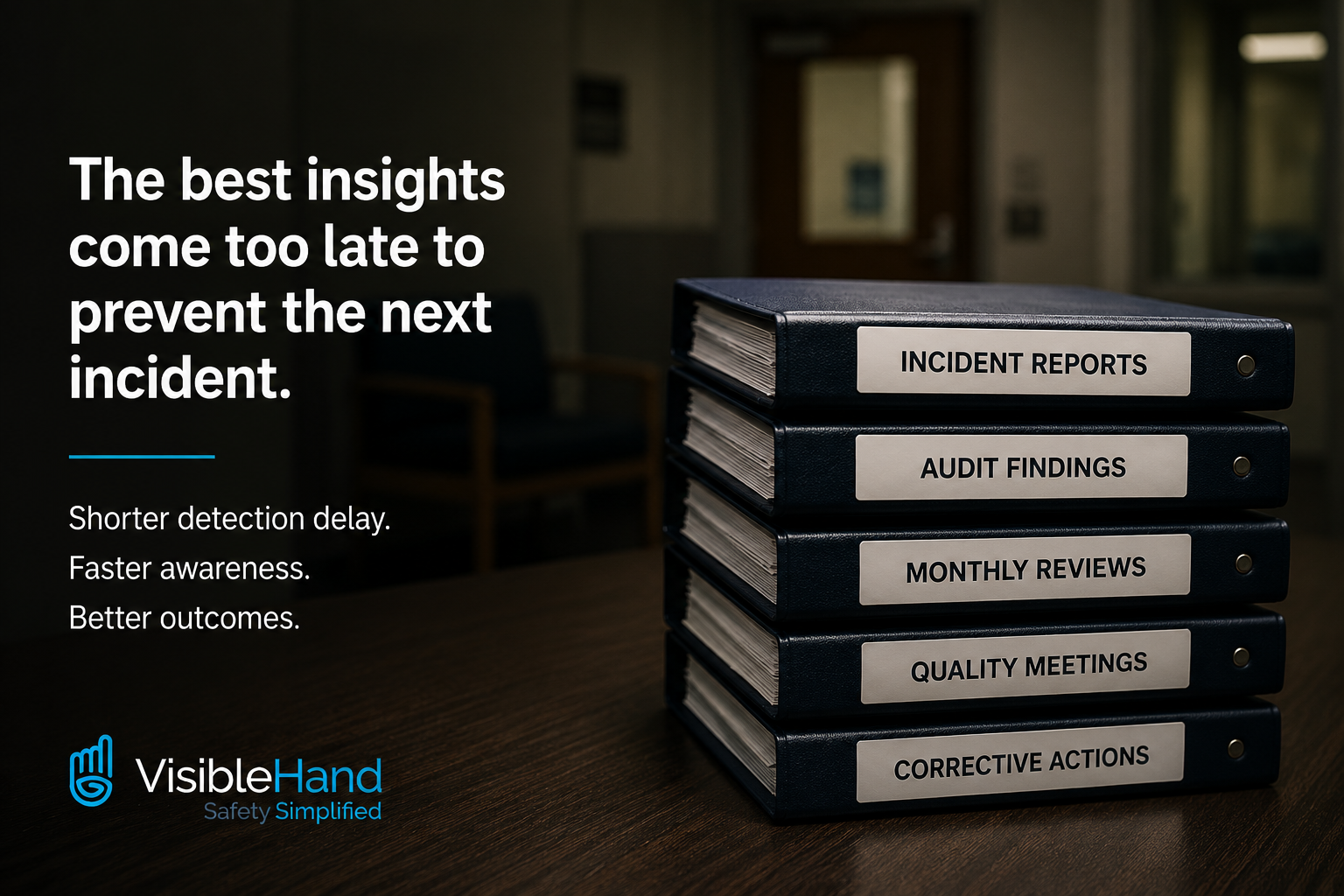
Behavioral health organizations are built around review. Incident reviews, chart audits, accreditation preparation, quality meetings, compliance reports, and corrective action plans all play an important role.
But review usually answers a backward-looking question:
What happened?
Operational awareness asks a different question:
What is happening right now?
Both matter, but they are not interchangeable.
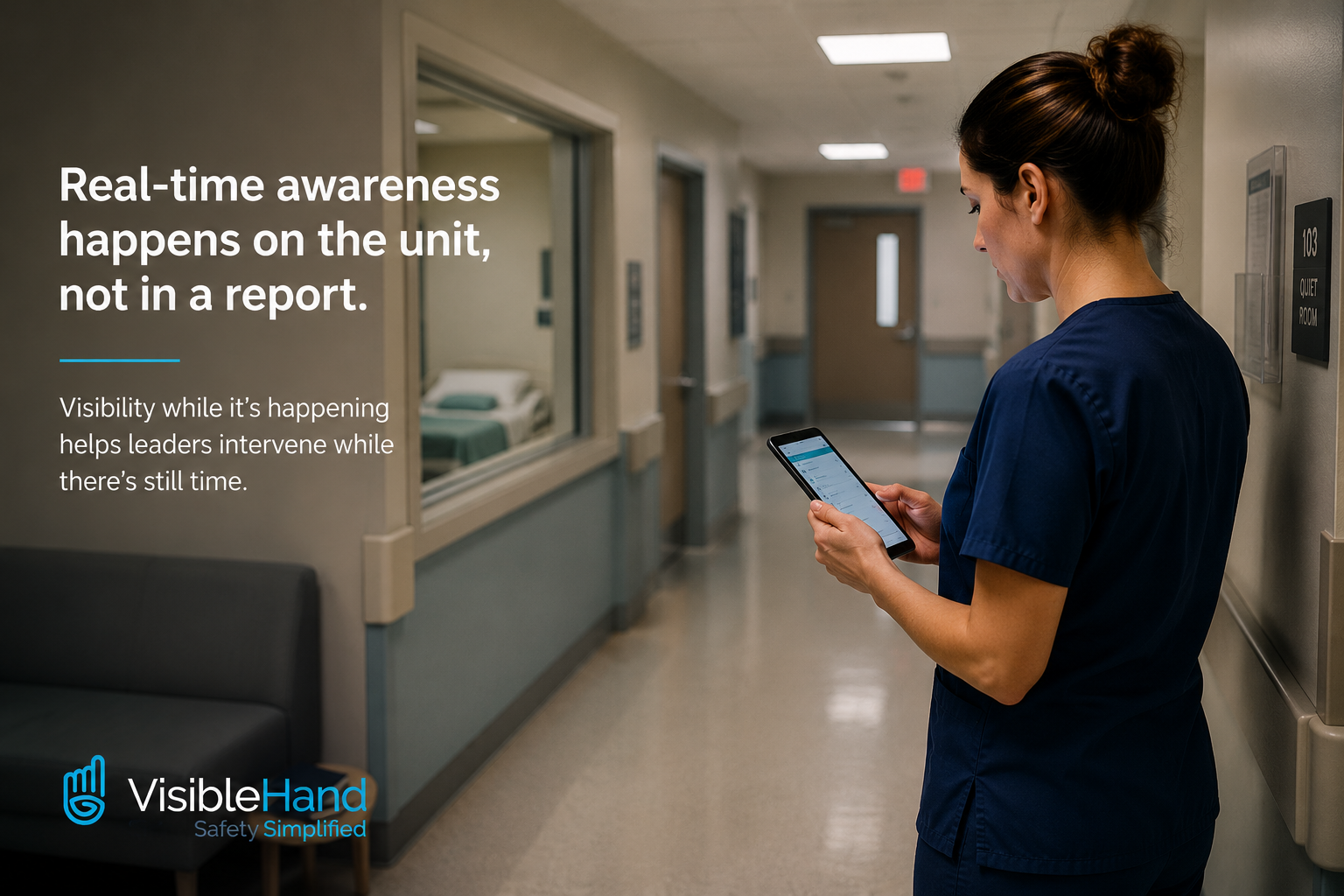
A monthly audit can show that a unit struggled with timely documentation. Real-time awareness can show that the unit is struggling during the shift, while there is still time to respond.
An incident review can help reconstruct a sequence of events. Real-time visibility can help leaders notice when a process is becoming unreliable before it becomes part of an investigation.
Review helps organizations learn. Awareness helps organizations act.
Compliance Can Hide Operational Risk
Compliance is necessary, but it can create a false sense of certainty when treated as the whole picture.
A process can look compliant on paper while becoming less reliable in practice. The forms may be complete. The required checks may be recorded. The dashboard may show an acceptable rate by the end of the day.
But that does not always answer the operational questions leaders care about most:
- Were checks completed when they were supposed to be completed?
- Were they performed in person?
- Were they documented at the time or later?
- Are certain shifts, units, or workflows starting to struggle?
- Would leadership know while the issue is still correctable?
These questions are not about blaming staff. They are about understanding how much confidence the organization actually has in its safety processes as they are happening.
Why Detection Delay Matters
The earlier an organization sees a problem, the more options it has.
If a manager notices missed or late checks during a shift, the response can be simple: adjust coverage, coach the team, clarify the workflow, or provide additional support. The issue is still current, and the people involved still have context.
If the same issue is discovered three months later, the response becomes harder. Leaders are reviewing old records. Staff are trying to remember details. The organization is reconstructing instead of responding.
Time turns manageable issues into uncertain ones.
That does not mean every issue can be prevented or every risk can be eliminated. Behavioral health is complex work, and serious events can happen even in strong programs. But reducing detection delay gives leaders a better chance to respond while a problem is still operational, not historical.
A Practical Test for Leaders
Pick one important safety process in your organization. It might be Q15 observations, environmental checks, patient location awareness, handoff documentation, or another process your team relies on every day.
Then ask:
If this process started failing consistently today, when would we know?
Would you know during the shift, at the end of the day, during a weekly review, at the next monthly quality meeting, during a survey, or only after an incident?
The answer reveals something important. Not whether your staff care. Not whether your policy is well written. Not whether documentation matters.
It reveals the detection delay built into the system.
The Goal Is Not More Documentation
Behavioral health teams already document a tremendous amount. Asking staff to record more is not always the answer.
The better goal is to shorten the distance between reality and awareness.
That means giving leaders a clearer view of whether critical safety processes are happening as expected, when they are happening, and where support may be needed. It means identifying drift before it becomes normalized. It means helping staff succeed inside the reality of busy, high-acuity environments.
Documentation will always matter. Audits will always matter. Review will always matter.
But the strongest safety programs do not rely only on after-the-fact review. They build systems that help them see problems earlier, respond faster, and reduce the uncertainty that grows when too much time passes between what happened and when leadership found out.
Free Tool: Assess Your Safety Detection Delay
To make this practical, we created a simple Safety Detection Delay Assessment.
Use it with your leadership, quality, or operations team to review your most important safety processes and ask one question:
If this process started failing today, how long would it take us to know?
The assessment helps you identify where your organization may be relying on after-the-fact review instead of real-time awareness, and where better visibility could make the biggest difference.