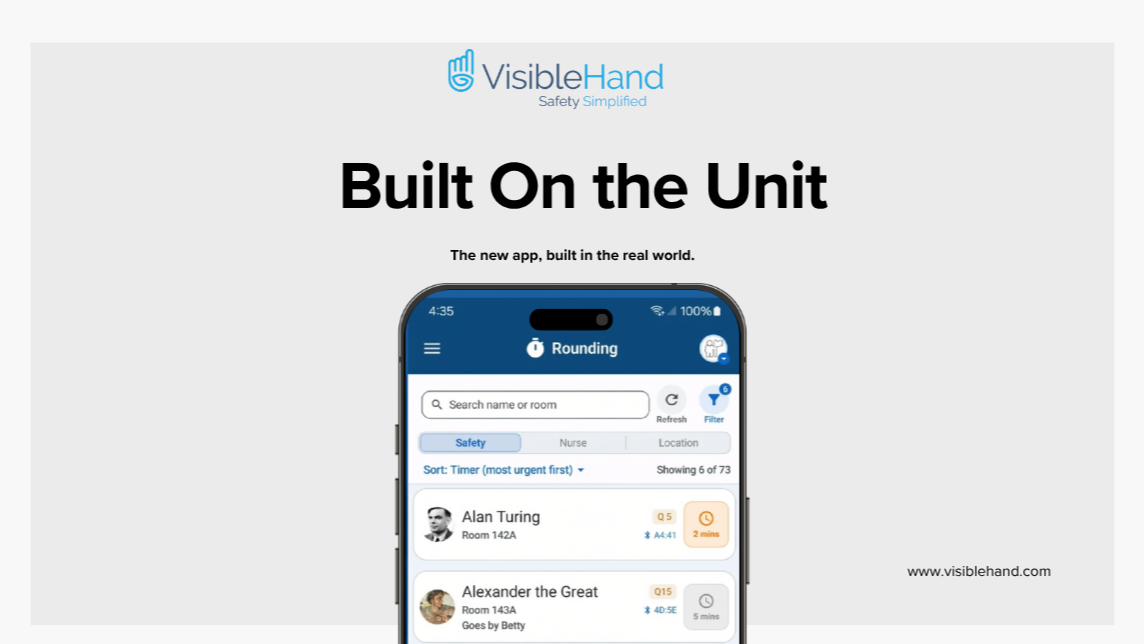
Built On the Unit
Every person at VisibleHand, our CEO, our software developers, our helpdesk team, everybody, spends at least one day a year on-site with our customers. It's not a suggestion — it's company policy. We bring donuts (of course), put on a badge, shadow nurses, MHTs, managers, and watch how the work actually happens instead of how it looks from our quiet offices.
We started doing this because software built entirely away from the floor tends to solve the problems that are easy to imagine instead of the problems that are actually there. Most healthcare software gets designed around the best-case version of a shift: strong WiFi, good lighting, a calm unit, well trained & motivated staff, one patient at a time. Our latest app version, however, is what happens when we go out looking for ideas, frustrations, opportunities instead of waiting for ideas to trickle & filter their way to us.
One of our engineers spent time with an MHT who works overnight and heard about how walking into a dark patient room made it difficult for their eyes to adjust and see what was happening in the room. That conversation led to dark-mode. A one-tap toggle between light and dark, built because someone on our own team felt it firsthand.
Offline mode came out of a similar visit, a unit where cellular was weak and WiFi dropped constantly. This isn't unusual — many facilities struggle with connectivity. We worked hard on offline mode, stability, and data preservation because losing signal isn't a what-if scenario, but a common occurrence. The app seamlessly saves everything locally and syncs the second you're back online. No paper, no second device, no gap in the record.
Some of what we learned didn't lead to a single clean solution, but instead multiple options. We visited two hospitals in the same month and heard two different philosophies on nurse audits: one wanted every round-review to occur within proximity of the patient, the other hospital had nurses do round-reviews from the nurses station and a separate Q check in-person. Both made real sense for how those specific units run. So instead of picking a side, we built both options, because the right answer depends on the hospital's policy, not on us.
Faster bluetooth scanning & load times, more sorting options built to find patients faster & create more awareness around rounds coming due, even the proactive alerts that nudge techs before a check is missed, all of it traces back to time spent actually watching a shift happen instead of imagining one from an office.
Over the next few weeks we're going to walk through each of these feature upgrades individually, what changed and why. But the throughline is the policy we started with: get everybody onto an actual unit, and build from what you see & hear while there.
Originally published on LinkedIn, September 1, 2026.