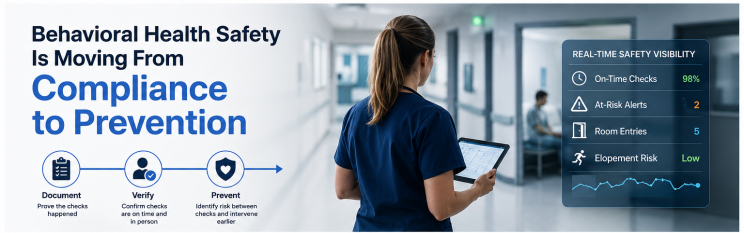
From Compliance to Prevention
For decades, psychiatric hospitals have relied on safety checks as a core practice for maintaining safe care environments.
The logic is sound. When patients are checked regularly, teams are more likely to identify risk, intervene early, and maintain visibility into the unit. Strong documentation also matters. In the aftermath of a suicide attempt, assault, elopement, self-harm event, or other serious incident, a complete safety record helps show that the hospital had appropriate policies in place and followed them in practice.
That work is important. It always has been.
But the industry is entering a new era.
Across behavioral health, the standard is beginning to shift from documenting that safety work happened to building systems that help prevent serious events before they occur.
That shift is being accelerated by recent legal outcomes, including verdicts and settlements large enough to change how boards, insurers, investors, and operators think about risk. These cases are not the whole story. They are public examples of a much broader reality.
Behavioral health is hard work. Serious events can happen in large systems, small hospitals, residential programs, public facilities, private facilities, and everything in between. Some become public through lawsuits, regulatory findings, media coverage, or enforcement actions. Many others are handled outside the headlines through internal review, insurance processes, corrective action plans, confidential legal resolutions, regulatory plans of correction.
No provider is immune.
That is what makes this moment so important.
The lesson is not that a few organizations failed while everyone else is safe. The lesson is that the entire industry is exposed to a level of clinical, operational, legal, and reputational risk that traditional compliance systems were never designed to fully manage.
The Old Model: Prove the Checks Happened
Safety checks have traditionally served two major purposes.
First, they support patient safety. Psychiatric hospitals are among the most difficult care environments in healthcare. Patients may be actively suicidal, self-harming, psychotic, manic, impulsive, aggressive, medically complex, vulnerable to victimization, or in acute withdrawal. Often, several of these risks exist on the same unit at the same time.
It takes special people to do this work. It also takes mission-driven organizations willing to care for patients during some of the most unstable and dangerous moments of their lives.
Second, safety checks create a defensible record. When a hospital can show that it assigned the right observation level, completed checks on schedule, and maintained complete documentation, it can demonstrate that it had a safety process and followed it.
That compliance layer still matters. It will always matter.
But compliance alone is no longer enough.
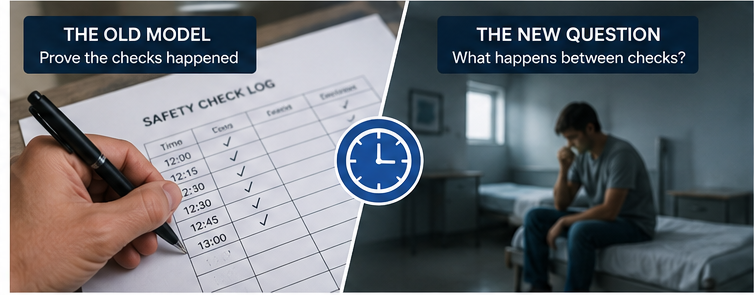
The New Question: What Happens Between Checks?
The hardest truth in behavioral health safety is that many serious events do not happen during the safety check itself.
They happen after staff leave the room.
They happen in the minutes between Q15 checks.
They happen when one patient enters another patient's room. When a patient stops moving. When a patient goes somewhere they shouldn't be. When agitation escalates faster than staff can see. When a patient's risk changes before the next scheduled observation.
That does not mean staff are careless. It means the environment is inherently difficult to monitor with episodic observation alone.
A paper sheet can tell you that a check was documented.
A digital log can tell you that a check happened on time.
A proximity-verified system can help confirm that staff were physically near the patient when the check was completed.
But the future of behavioral health safety is pushing toward a harder question:
Can we identify risk while there is still time to intervene?
From Safety Check Compliance to Safety Infrastructure
This is the industry shift.
The goal is no longer simply to document that observations occurred. The goal is to build safety infrastructure around the unit.
That infrastructure may include digital rounding, proximity verification, real-time dashboards, alerts for late or missed checks, environmental rounding, patient location awareness, room-entry alerts, elopement detection, movement monitoring, contact tracing, and eventually AI-driven risk indicators.
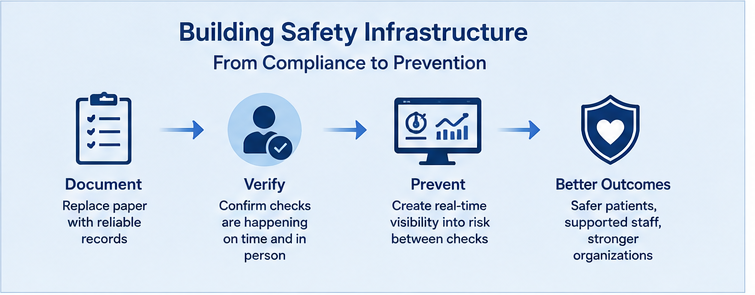
The progression is clear:
Document: Replace paper with reliable, time-stamped records.
Verify: Confirm that checks are happening on time and in person.
Prevent: Create real-time visibility into risk conditions that emerge between scheduled observations.
This is not about replacing staff. It is about supporting them.
Frontline teams are already carrying an enormous burden. They are managing patients in crisis, de-escalating conflict, documenting care, supporting admissions and discharges, coordinating with nurses and clinicians, and responding to unpredictable behavior in real time.
Technology should not add complexity to that work. It should make the safest action easier, faster, and more visible.
Leading Operators Are Already Moving
The most forward-looking behavioral health organizations are not waiting for the perfect regulatory mandate or the perfect technology stack. They are already moving.
Some are replacing paper logs with digital rounding.
Some are adding proximity verification to ensure that checks are happening in person.
Some are building real-time dashboards into nursing leadership workflows.
Some are standardizing safety rounding across multiple facilities.
Some are beginning to explore patient location, room-entry alerts, wearable sensors, movement monitoring, and other tools designed to identify risk between observations.
That matters because the organizations that move first are not simply reducing documentation risk. They are building learning systems.
They can see where checks are late.
They can identify units or shifts that need more support.
They can spot workflow breakdowns before they become normalized.
They can train with better data.
They can respond to surveyors and regulators with cleaner records.
Most importantly, they can give leaders and frontline teams more visibility into the safety work happening across the facility.
A Difficult Moment, But a Necessary One
Large verdicts and settlements create real pressure. They affect insurance markets, board conversations, capital planning, acquisition risk, and expansion strategy. In a sector that already faces staffing shortages, reimbursement pressure, and a national shortage of behavioral health capacity, that pressure is significant.
There is a real risk that elevated liability could make it harder to open new beds or sustain existing programs.
But there is also a more hopeful possibility.
Moments like this can force industries to modernize.
Aviation became safer through better systems, not just better pilots. Medication administration became safer through barcoding, electronic records, and closed-loop processes, not just reminders to be more careful. Behavioral health safety can evolve the same way.
The future will not be built by pretending risk can be eliminated. It cannot.
The future will be built by organizations that acknowledge the difficulty of the work and invest in better systems around the people doing it.
The Future Is Prevention
Compliance will always matter. Policies will always matter. Documentation will always matter.
But the next era of behavioral health safety will be defined by prevention.
Not just: Did the check happen?
But:
- Was it on time?
- Was it in person?
- Was the patient where they were supposed to be?
- Did risk emerge between checks?
- Could staff have been alerted sooner?
- Can leaders see patterns before they become incidents?
- Can the organization learn faster than risk accumulates?
That is the shift underway.
It is not about blame. It is about maturity.
Behavioral health providers are caring for some of the most vulnerable patients in healthcare, in some of the most complex environments in the system. The work is hard, the stakes are high, and no organization is immune from risk.
The next generation of safety will belong to providers who are willing to go beyond minimum compliance and build systems that help staff see more, respond faster, and prevent more harm.
That future will require investment. It will require operational change. It will require innovative providers and innovative partners working through messy, real-world use cases that do not always follow a straight line.
But if the result is safer patients, better-supported staff, stronger organizations, and more confidence in behavioral health care, then it is a future worth building.