What is a Q15 Minute Safety Check?
Basic Q15 Minute Safety Check Processes
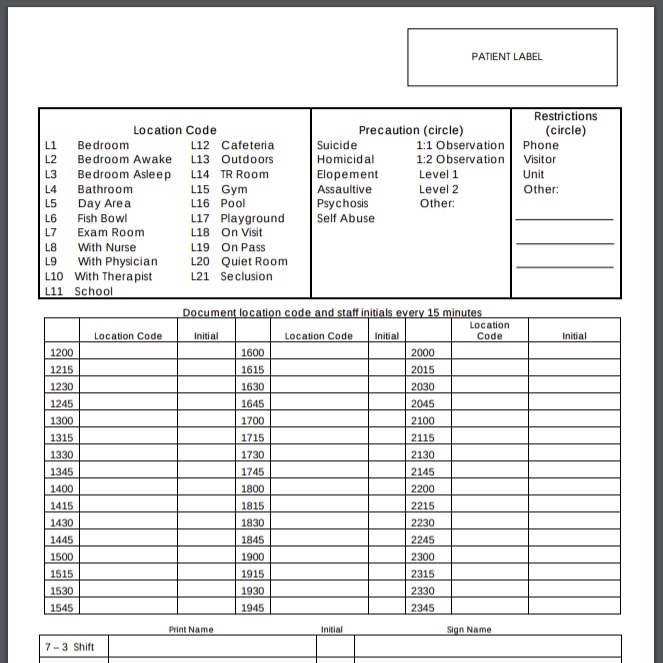
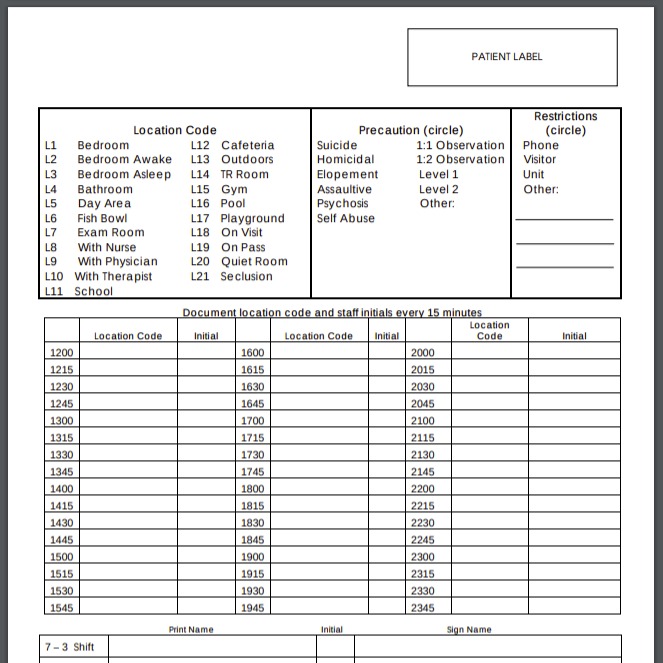
The primary goal of inpatient behavioral treatment is to keep patients safe from themselves and each other while they receive treatment so that they can return to the community. The consistent presence of caregivers is one of the foundations of safety. To ensure direct care staff are consistently setting eyes on each patient, hospitals have adopted Q15 minute safety checks. Historically, these are documented on a paper form (like the picture above) and are stored on-site for multiple years.
Definition - Q15 Minute Safety Checks are generally:
-
A Q15 is a safety check occurring every 15 minutes.
-
Q, meaning "every" (Latin, quaque)
- 15 minutes is the interval, for a Q15, but you may see Q60 for lower acuity patients, Q4h water checks, Qshift environmental checks, etc.
-
The primary responsibility of front-line caregivers (health tech, etc.).
-
Reviewed/Audited by nurses periodically to ensure patient health and front-line compliance.
-
Require visual contact with patient
-
Sometimes within a certain number of feet or 'arms reach'
-
Confirms signs of life (ie. breathing while asleep)
-
Confirms location (ie. check against elopement)
-
Notes patient activity/affect (ie. check for behavior risks)
-
Documented via a Q15 minute check form, (see sample Q15 minute check pdf)
-
Stored physically or electronically for future reference.
-
Q15 is typically the minimum level of contact between caregivers and patients on an inpatient unit.
-
Some patients may be on "close observation" (always line of sight) or "1-on-1" (always arms reach) depending on their precautions, suicide risk, etc.
*** Note: Individuals, teams, and organizations define safety checks differently. See these survey responses when psychiatric nurses were asked to define “Safety Check” [LINK] ***
CLICK HERE to receive a free Q15 form that you can use on your unit. It is based on industry best practices and fully customizable.